Exhibition stand budgets are one of the most searched and least transparently answered questions in the trade show industry. Contractors rarely publish prices. Exhibitors rely on outdated estimates or quotes from previous years. And the gap between what brands expect to pay and what premium execution actually costs creates friction at exactly the wrong moment — when a show deadline is approaching.
This guide breaks down exhibition stand costs for 2026 across the markets EFFECT Global operates in: the Middle East and North Africa, Europe, and Sub-Saharan Africa. The figures reflect real project ranges, not theoretical minimums.
What Drives Exhibition Stand Costs
Before the numbers, understand the variables. Exhibition stand pricing is not a flat rate. Four factors determine where your project lands on the cost spectrum.
Stand size and format. A 9sqm inline stand and a 200sqm island pavilion are not comparable products. Size is the single biggest cost driver. Format matters too — a double-decker stand requires structural engineering, safety sign-off, and significantly more fabrication time than a single-level build.
Material specification. The difference between a stand built with fabric tension systems and one built with high-gloss lacquered MDF, solid timber, stone surfaces, and bespoke metalwork is significant. Both can look impressive in a render. The difference shows on the floor.
Market and venue. Labour costs, freight rates, venue handling fees, and local material availability vary enormously between markets. Building a stand at Messe Frankfurt costs more than building the equivalent stand in Tunis or Cairo — not because the design is different, but because the operational cost base is different.
Timeline. Rush projects cost more. A stand briefed 12 weeks before the show runs on a standard production timeline. The same stand briefed 4 weeks before the show requires overtime, expedited freight, and premium supplier scheduling. The design does not change. The cost does.
Exhibition Stand Cost Ranges by Type
Modular Stands (9–36 sqm)
$8,000 – $25,000
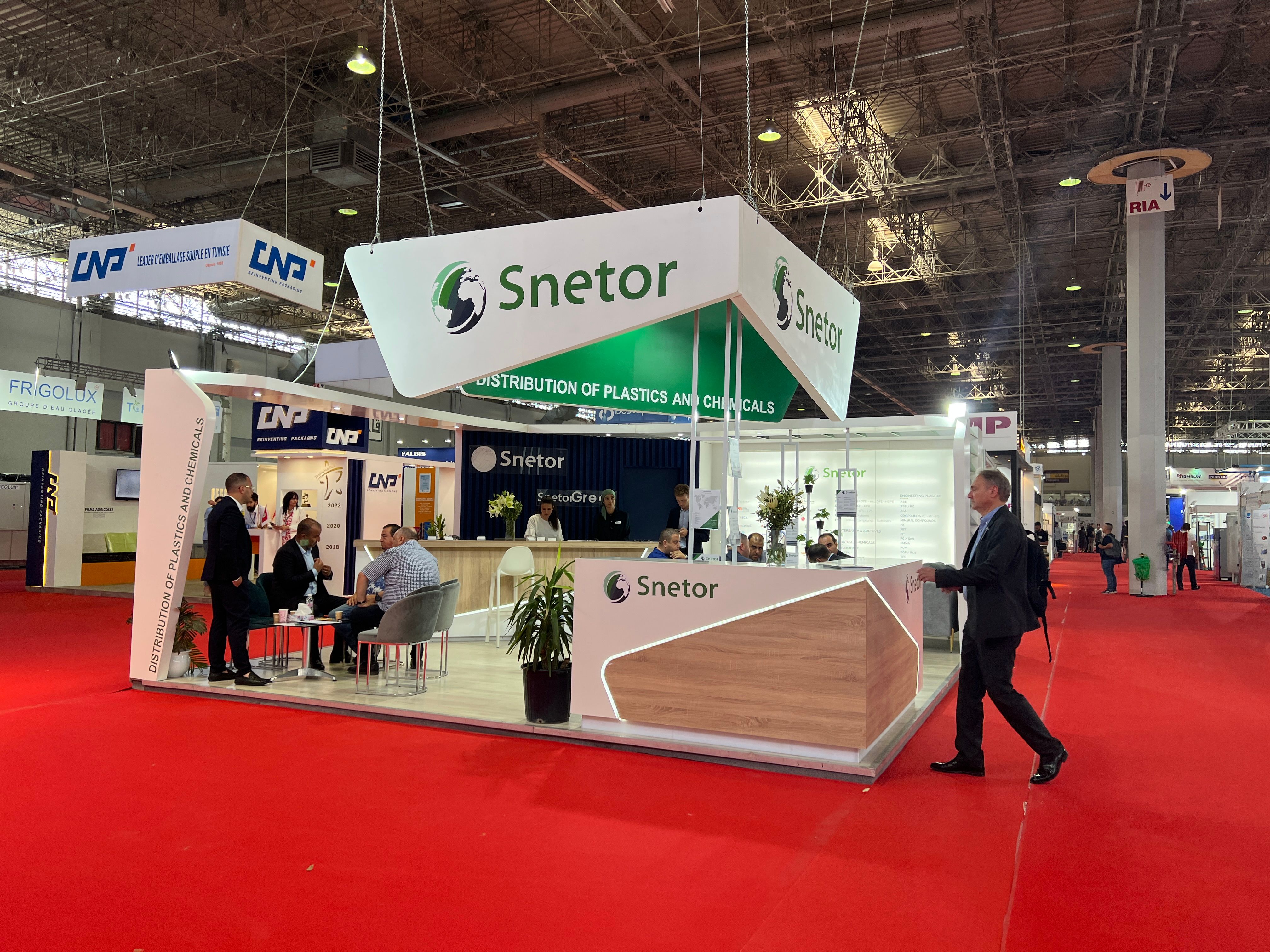
In Tunisia, modular stands in this size range start from 120 USD/sqm under EFFECT's Pack 1 and Pack 2, making them accessible entry points for local exhibitors at Carthage Expo and the Kram Exhibition Centre.
Custom Inline and Peninsula Stands (12–50 sqm)
$15,000 – $45,000
In Tunisia, custom inline stands in this range are covered by EFFECT's Pack 2 (10 to 36 sqm from 180 USD/sqm), offering full creative freedom within a transparent pricing framework.
Custom Island Stands (36–120 sqm)
$35,000 – $120,000
In Tunisia, large format island stands fall under EFFECT's Pack 3 (40 sqm and above from 250 USD/sqm) — the flagship format for market leaders at SIAT, Carthage Expo, and the Salon du Bâtiment Carthage.
Double Decker Stands (50–200 sqm)
$80,000 – $250,000+
Two-storey structures that transform floor space into private meeting real estate above and open engagement space below. Structural engineering, venue approval processes, and extended installation windows add significant cost beyond single-level builds of equivalent footprint.
Best for: Large-format exhibitors at major international fairs, companies needing private meeting infrastructure, and brands where VIP hospitality is part of the show strategy.
Country Pavilions and National Stands (200–1,000+ sqm)
$150,000 – $500,000+
Government-commissioned national representation at international trade fairs. These projects involve multiple exhibiting companies within a single national identity framework, complex logistics across multiple production facilities, and often multi-country delivery programmes. EFFECT has delivered national pavilions for government trade bodies across Africa and the Middle East.
Best for: National export promotion agencies, ministries of trade, and government institutions representing their country at international exhibitions.
Tunisia Pricing: What EFFECT Charges for Exhibition Stands
EFFECT Global is the only exhibition stand contractor in Tunisia that publishes transparent pricing. For stands built and delivered at Carthage Expo, the Kram Exhibition Centre, and all major Tunisian venues:
Pack 1 — 6 to 9 sqm: from 120 USD/sqm
Ideal for first-time exhibitors and brands testing the Tunisian market. Includes 3D design, fabrication, transport, installation, and dismantling.
Pack 2 — 10 to 36 sqm: from 180 USD/sqm
The most popular range for established brands at Tunisian trade fairs. Includes premium materials, LED lighting, meeting area, and product display zones.
Pack 3 — 40 sqm and above: from 250 USD/sqm
Large format custom stands with architectural design, multiple meeting rooms, hospitality zones, and full AV integration.
Pack Pavillons — National pavilions and large multi-brand stands: from 300 USD/sqm
For government trade bodies, export promotion agencies, and multi-company national representation at international shows. EFFECT has delivered national pavilions for CEPEX and ONTT.
All prices are in USD per sqm and include the full project lifecycle — concept design, fabrication at our Tunis production facility, transport to the venue, installation, supervision during the show if required, and dismantling. For a detailed itemised proposal based on your specific brief, contact us directly.
Cost by Market: What Changes Between MENA, Europe, and Africa
The same stand design costs different amounts to build and install depending on where the show is.
Europe (Germany, France, Italy, Belgium, Netherlands, Spain)
Europe is the most expensive exhibition market in the world on a cost-per-sqm basis. Frankfurt, Milan, and Amsterdam set the benchmark. Labour rates are high, venue handling fees are significant, and freight from North Africa or the Middle East adds logistics cost. Expect to budget at the upper end of the ranges above for shows at Messe Frankfurt, Fiera Milano, or Brussels Expo.
Key cost factors: High union labour rates at venues, strict technical regulations requiring certified structural drawings, premium freight costs, venue-specific restrictions on materials and installation methods.
Middle East (Qatar, UAE, Saudi Arabia)
The Gulf is a mid-to-high cost market. Venue standards at DWTC, ADNEC, and Doha Exhibition and Convention Center are high, and exhibitors are expected to match them. Labour costs are lower than Europe but freight from Europe or Asia adds cost. Local production capacity in Qatar and the UAE has improved significantly, which helps brands with regional programmes.
Key cost factors: Freight from production markets, venue handling fees, summer heat affecting installation conditions, high visitor and VIP expectations raising finish quality standards.
North Africa (Tunisia, Morocco, Algeria, Egypt)
North Africa is the most cost-efficient market for exhibition stand production. Local fabrication capacity is strong — particularly in Tunisia — and labour costs are significantly lower than European or Gulf benchmarks. Brands running regional programmes often use North African production as a cost-efficient base for stands that travel to multiple markets.
For exhibitors at Tunisian shows — Carthage Expo, the Kram Exhibition Centre, SIAT, and the Salon du Bâtiment Carthage — EFFECT Global publishes transparent pricing for stands built and delivered in Tunisia:
Pack 1 — Small stands (6 to 9 sqm): from 120 USD/sqm
Pack 2 — Medium stands (10 to 36 sqm): from 180 USD/sqm
Pack 3 — Large stands (40 sqm and above): from 250 USD/sqm
Pack Pavillons — National pavilions and large multi-brand stands: from 300 USD/sqm
All packs include 3D design, fabrication, transport to the venue, installation, and dismantling. No hidden costs.
These figures represent a first-mover transparency signal in the Tunisian exhibition market — no other contractor in Tunisia publishes pricing. For brands evaluating exhibition stand investment in Tunisia or Algeria, these benchmarks provide a reliable starting point for budget planning.
Key cost factors: Lower labour and material costs, improving logistics infrastructure, growing exhibition calendar across Tunis, Algiers, Casablanca, and Cairo.
Sub-Saharan Africa (Ivory Coast, Morocco, West Africa)
An emerging exhibition market with growing trade fair calendars in Abidjan, Casablanca, and Lagos. Production infrastructure is developing and costs vary significantly between venues and cities. EFFECT has delivered stands in West Africa and manages the logistics complexity of these markets.
Key cost factors: Variable production infrastructure, freight complexity, growing but not yet mature venue ecosystems.
What Is Not Included in Stand Build Costs
Exhibition stand quotes from contractors typically cover design, fabrication, logistics, and installation. The following costs are usually separate and need to be budgeted independently.
Space rental from the show organiser. This is paid directly to the trade fair organiser and is not part of the stand build contract. Costs range from €150 to €600 per sqm at major European shows.
Furniture and flooring from the organiser. Some venues require you to use their approved suppliers for certain elements.
AV equipment. Screens, LED walls, interactive technology, and sound systems are often quoted separately or as an add-on to the stand build.
Graphic production. Large-format printing, vinyl application, and digital content production may be included or quoted separately depending on the contractor.
Travel and accommodation for installation crews. For international projects, the cost of getting your contractor's team to the venue is part of the project cost.
Dismantling. Post-show breakdown, material disposal or storage, and return freight are often quoted as a separate line item.
How to Get an Accurate Exhibition Stand Quote
The single biggest factor in getting an accurate quote is the quality of your brief. Contractors who quote without sufficient information will either over-estimate to cover unknowns or under-estimate and revise upward later.
To get a reliable proposal from EFFECT or any serious contractor, prepare the following before reaching out:
- Show name, dates, and venue
- Your allocated floor space in sqm and the shape of your allocation (corner, inline, island)
- Hall and stand number if already confirmed
- Your brand guidelines or visual identity references
- Any specific functional requirements: meeting rooms, product display areas, demonstration zones, storage
- Whether you need AV and what type
- Your target budget range — even a broad range helps contractors calibrate the right solution
The more specific your brief, the more accurate and useful the proposal you receive.
The Real Cost of Underinvesting in Your Exhibition Stand
The floor space you rent from a trade fair organiser is one of the most expensive marketing real estate purchases your brand makes per square metre. An exhibition stand that fails to stop visitors, communicate brand positioning, or create the conditions for commercial conversations wastes that investment entirely.
The cost difference between a stand that performs and one that does not is rarely as large as brands expect. Moving from a €15,000 modular system to a €35,000 custom build at a show where your competitors are investing €80,000 changes the commercial conversation you can have on the floor.
Exhibition stands are not a cost. They are a commercial instrument. Budget accordingly.
For Tunisia-specific pricing and a full breakdown of what is included in each pack, see our dedicated Tunisia stand pricing page: Stand Sur Mesure Tunisie — Prix & Packs.